
PRESS
The Invisible Paths of Noise and Memory
An interview with War San about Osynliga Stigar—a record shaped by analogue noise, inherited memories, and century-old pianos turned into sonic sanctuaries.
By Borja Coquillat
Two roads diverged in a wood, wrote Robert Frost, and perhaps Osynliga stigar was born precisely at that crossroads: the moment when someone chooses to veer onto the less-travelled path, even while suspecting there may be no comfortable way back. The title of War San and Ragnar Bey’s album means “invisible paths,” though here the phrase functions less as a poetic metaphor than as a working method. These songs move forward by feeling their way through the darkness, allowing noise, resonance, and certain accidents to discover their own logic. It is as if the album were recorded by following barely perceptible signals: an inherited piano, a particular room, the memory of a journey, a deteriorating tape, the echo of conversations that began more than twenty years ago.
The story behind this meeting begins far from the contemplative ambient label someone might be tempted to apply too quickly. Kim Warsén and Ragnar Bey first met while travelling across Europe as street musicians. In early-2000s Madrid they formed a band called Blues Tumulto—playing percussion on urban scrap metal, using boots as bass drums, and delivering performances so exhausting that they rarely lasted more than fifteen minutes. Decades later, they would create an album in which every silence seems placed with the precision of a sleepless watchmaker.
In between came Crash Nomada, the Spanish alternative scene, old organs rescued from Småland, abrasive guitars recorded almost like exorcism sessions, and a century-old piano that became the emotional centre of the entire record.
What makes Osynliga stigar so fascinating is that it never quite settles into comfort. There is calm, certainly, but it is a calm constantly pierced by friction, dissonance, and small cracks that prevent the album from becoming mere atmospheric decoration for perfectly ordered apartments and people who pronounce “vinyl” as though discussing a variety of French cheese. War San and Ragnar Bey understand sound as a physical presence: wood creaks, air carries weight, strings bear the marks of wear, and the songs seem more interested in provoking states of mind than in displaying formal perfection.
During the conversation, names such as Godspeed You! Black Emperor, Sonic Youth, David Lynch, and Jodorowsky emerge, but the most compelling moments arrive when the interview enters territory that is harder to explain: the idea that “there are no innocent notes,” music as a form of resistance in an increasingly intangible world, and the need to preserve a certain human imperfection within the recording itself.
Amid family roots, Swedish villages turned into ghostly landscapes, and paths disappearing into the undergrowth, Osynliga stigar ultimately functions like those places one can never quite locate in memory, though one could swear they have passed through them before.
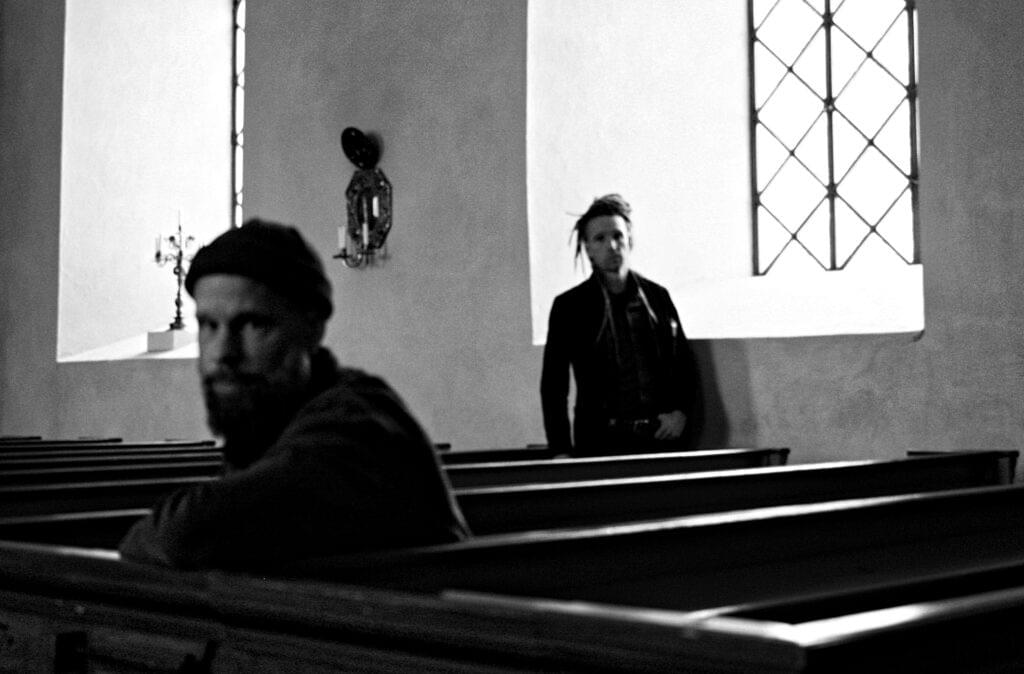
Q: For many Spanish readers, War San and Ragnar Bey will still be names waiting to be discovered. You come from a musical universe shaped by minimalism, resonance, and analogue experimentation, while Ragnar arrives from the worlds of Crash Nomada, folk-punk, travel, and a more physical relationship with composition. How would you describe your respective paths, and what was it that ultimately allowed this collaboration to crystallise into Osynliga stigar?
A: I suppose it all comes down to a growing sense of brotherhood. We met in 2000 while both travelling across Europe as street musicians. Our first band together was formed in Madrid around 2004 and was called Blues Tumulto. I played percussion on scrap metal found in the streets while he carried an acoustic guitar; we used our boots as bass drums and shouted until our lungs gave out. The performances were so exhausting that they never lasted more than fifteen minutes. Later, Ragnar returned to Sweden and formed Crash Nomada, while I spent about ten years immersed in Spain’s alternative music scene.
It’s true that we carry different musical influences and come from different traditions in certain respects, but we also share something very deep. I’m not entirely sure what to call it—perhaps a kind of spiritual longing, something that can be reached through ritual, solidarity, music, art in general...
Q: Even before the music has fully unfolded, Osynliga stigar establishes a very specific atmosphere: suspended roots, ancient earth, something organic yet also ghostly. The cover artwork feels deeply connected to the sound of the album. Did the visual dimension emerge early in the process?
A: It's very beautiful to hear that, and I think it captures perfectly what this record is about. We've tried to bring together our roots and carry the spirits of our ancestors with us. The recordings were built around Ragnar's piano, which he inherited from his grandmother, and I later discovered that his mother used to play it as a child as well. Ragnar's mother, Helen Ekholm, who is a painter, created the artwork, so it would be hard to imagine a deeper connection to the roots of the project.
I've always loved her paintings, and Ragnar has several of them hanging in his home. When we decided to use some of them for the album, it felt like adding another dimension. There's a warmth in them, something worth pursuing.
Q: Listening to the album, one gets the impression that you were less interested in constructing closed compositions than in leaving traces: resonances, tensions, emotional shifts that emerge and disappear. What was the creative process between the two of you actually like?
A: I think for both of us it had much more to do with trying to capture and convey a state of mind than with recording songs, although some of the pieces had been written beforehand. I usually play my compositions many times before recording them, but once I enter the studio I try to forget the composition itself and allow the song to reveal itself on its own.
Since the task was to pass these pieces through that particular piano, it was important to remain attentive to the way the instrument transformed them and simply follow where it led. I've had experiences while playing that felt as though I was being guided by something beyond myself, and I try to remain open to that. It's not something I could really explain, and perhaps it doesn't need explaining.
Some of the tracks came to life from Ragnar's guitar-noise improvisations—almost exorcistic sessions full of tension, genuinely beautiful and tormented. He would send me the recordings, and I would then add structure and harmony before he returned to re-record the guitars.
Altogether, we worked on this for more than a year, although Ragnar's piano recordings—which ultimately became the foundation for six pieces—were made in a single session.
Q: There is something profoundly physical about these recordings. You can hear the wood of the instruments, the air surrounding the piano, the wear in the strings, even the room itself. At a time when so much music seems designed to float without weight or texture, you insist on material presence. Did you need the sound to carry scars and density?
A: That feels like a very fair description. Material presence creates a kind of friction, and we were very conscious of that throughout the entire process. There was always a risk that introducing all those unconventional elements into the soundscape simply wouldn't work, or that they would overwhelm everything else, but Göran Frid did an incredible job with the mix.
And we knew from the beginning that the record would carry scars and density—that it would be the exact opposite of something clean and polished—because it's built around a piano that is more than a hundred years old. But that was precisely what attracted us. Ragnar has a very strong relationship with that instrument, and we wanted to discover where it could take us.
I suppose there is also a certain statement of intent in that, although above all it simply felt like the coherent way to do it. We are living in a moment when the physical world seems to be slowly fading before our eyes. Resistance through sound is a tradition that both Ragnar and I hold very close to our hearts, from Kurt Schwitters' Dadaist compositions right up to the present day.
Q: At several moments the album reminded me of a certain spirit within late-1990s and early-2000s post-rock—not so much stylistically as in the way silence, tension, and space are treated as central compositional elements. Were you interested in reconnecting with that sensibility?
A: It wasn't a deliberate attempt to connect specifically with that era of post-rock, although I do think there is an obvious affinity in the rejection of dominant musical logic. The spirit of that post-rock demanded patience, contemplation, and resistance to the structures of commercial music. There was also a desire for the listener to find a certain peace within uncertainty, and I think that's where we do overlap.
Personally, bands like Godspeed You! Black Emperor created a much-needed space for collective mourning in the late 1990s, offering hope and resistance at the same time. So yes, in that sense I think you're right. Ragnar, however, leans much more toward unconventional approaches and the structural thinking of Sonic Youth. That's where we come from different traditions.
I listened to a great deal of that post-rock during those years, but I think this album would be far less interesting if Ragnar came from exactly the same place.
Q: What fascinates me about the album is that it never fully settles into calm. There is always some dissonance, a certain friction, or an unstable current disturbing the balance. Do you distrust beauty when it becomes too polished?
A: I'd like to simply answer "yes" and move on, but let's talk about it. For me, there are no innocent notes. I connect deeply with that idea in any kind of music or artistic expression, and I hope it runs through everything I do.
I find it difficult not to perceive something manipulative in excessively polished beauty, although I'm aware that this says as much about me as it does about the music itself. This album seeks calm and a certain sense of reconciliation, but it doesn't want you to surrender or become obedient. There would be something dishonest in embracing that kind of expression.
Q: Your compositions tend to evolve through emotional accumulation rather than through grand dramatic explosions. How did that way of working interact with Ragnar Bey's more restless and vocal energy?
A: I suppose that, in some ways, it might seem as though Ragnar represents the restless present, but I think that ultimately saved many of the songs. I always try to find a balance between calm and a certain degree of imperfection; for me, the human element is the most valuable thing when it comes to validating a recording.
Ragnar's presence allowed me to explore something comforting and peaceful more freely because I knew he would provide the counterbalance. In truth, our friendship works both ways. Very often, his presence also calms and reassures me.
Q: Osynliga stigar moves between antique instruments, almost liturgical resonances, and bursts of electric abrasion. On paper these elements might seem incompatible, and yet the album finds a remarkably natural balance between them. How did you arrive at that point?
A: I think Ragnar expressed it very well when he said that "the world is becoming increasingly fragmented and polarized." If we accept that description, then it should be the task of creativity to bring together what appears incompatible.
With the right intention, and if we have done enough work on ourselves, we should be able to meet one another and build common ground regardless of the elements we bring with us. In that sense, if the album has managed to do that, then it contains some form of hope.
Q: The album contains a strange geography: Småland, Västmanland, Istanbul, but also empty stations and borrowed rooms suspended somewhere between memory and transit. How do places enter your music without becoming mere aesthetic decoration?
A: Within the tradition of Jodorowsky's Psychomagic, which fascinates me greatly, you can use places, objects, or people that carry meaning for you and transform the way you perceive them through rituals. You can recreate your own history, rewrite your experiences, and so on.
I tend to work within that tradition, although the process cannot be overly rational or conscious. It's like bringing ingredients to a table and, as you work with them, they begin to make sense and new patterns emerge.
For example, there is a song that began as a kind of hymn to David Lynch. Later we added the voice of my late grandfather, which I had recorded many years ago, and eventually named the piece Orrefors, the place where he lived. That village feels rather ghostly today, with an atmosphere that is extraordinarily Lynchian. Everything fits together perfectly, but the meaning emerged during the process—it wasn't constructed beforehand.
Something similar happened with Kediköy, where Ragnar plays a Saz Cümbüs, a Turkish instrument that brought him back to his years in Istanbul, and especially to that harbour district. But we weren't writing a song about that place; it simply connected itself to it and naturally became the title.
Q: Much contemporary ambient music functions almost like elegant furniture for carefully curated interiors. Osynliga stigar feels far less comfortable than that. Were you consciously trying to avoid making purely ornamental music?
A: Yes, ambient music is often associated with that, and I suppose we were aware of it. Throughout this project, both of us viewed our instruments as a kind of shamanic tool. They were there to help us create emotional or spiritual states, to be used for catharsis, personal growth, overcoming obstacles, and discovering spaces—secret rooms, if you like.
We wanted to capture and transmit that journey, that experience, rather than turn it into a rentable product. Because of that, it made no sense to decorate it or make it "prettier." Having said that, at one point I added some digital synthesizers, but Ragnar asked me to remove them—and he was absolutely right.
I hope some people will perceive this as an incorruptible approach. I may be wrong, but I like to think that this music could spark curiosity in someone who stumbles upon it fifty years from now. Perhaps it won't, I don't know. But it contains sounds with a physical and emotional presence that are not trying to please the power structures that dominate contemporary culture.
Q: Some pieces move as if circling around something that never fully reveals itself, like stories in which the essential event always happens off-screen. Are ambiguity and absence important parts of your language as composers?
A: I try to involve myself in projects and creative processes from which I can learn something. If the message is already fixed beforehand, it simply doesn't interest me. There has to be some uncertainty, some new territory to discover.
I suppose that makes it inevitable to communicate through a certain degree of ambiguity, as though circling around something that never completely reveals itself. On the other hand, when everything is explained to the listener, something seems to be lost—the very space where meaning is born. And that is the space that interests me most.
Q: After so many years of shared affinities and conversations, does Osynliga stigar feel like an arrival point, or more like the beginning of a dialogue that still has a long way to go?
A: I don't know—perhaps both. While making this album we recorded several songs that didn't quite fit and set them aside for a future project, perhaps even a new band.
But considering all the invisible paths we travelled to arrive here, it also clearly feels like some kind of destination. In many ways I enjoy getting older. My curiosity continues to grow, and all sorts of impulses become easier to channel into something constructive.
So yes, perhaps you could say that this album brought us to the starting point.
"There is something profoundly human in the unpolished."
On Osynliga Stigar, released into the world yesterday, WAR SAN (Kim Warsén) meets Ragnar Bey from the wonderful Crash Nomada. (Be sure to check out their latest single, Sister Europa!) I've always loved musical collaborations, and here both Kim and Ragnar weave together not only their roots but also their musical worlds. In pieces such as Till Lisa and the closing track Tegelfärgad skymning (Brick-Coloured Twilight), moods intertwine in a way that leaves me both captivated and envious. I keep returning especially to the former. There's something about the meeting between fragility and weight. It's endlessly beautiful.
Today, I spoke with Kim and Ragnar about the album—and, of course, about Småland.
Q: How are you both doing?
A (Kim): Thank you, I'm doing well. It feels wonderful to finally release this album. We began working on it back in the autumn of 2024, so there's something almost ceremonial about bringing a long-term project safely into harbour.
Q: You describe the music as a form of resistance to "digital perfection." Do you feel that a lot of music today has become too polished to feel genuinely human?
A (Kim): Yes, I suppose we do think that (laughs). But really, it's an ongoing tension, isn't it? The struggle between settling into something established and universal, and the desire to find an authentic and sincere expression.
I think it's important to reflect on contemporary trends and decide to what extent we want to uphold them or challenge them. This album is built around an old inherited piano, its memories, and the possibility that those memories somehow remain stored within its acoustics. Ragnar's close relationship with this particular piano affected me deeply and influenced the way I approached the instrument.
All of those factors fascinate me. There is something profoundly human in the unpolished.
Q: Osynliga Stigar seems to move between stillness and confrontation. How do you find the balance between beauty and discomfort without allowing one to overpower the other?
A (Ragnar): I think that balance emerges quite naturally through our collaboration. It's about giving and receiving space within the music.
As the guitarist in this constellation, it's just as much about not playing as it is about playing. That may sound like a cliché that goes all the way back to John Cage and Zen Buddhism, but silence—and the act of not playing—is enormously important in this kind of music.
Q: You mention both Arvo Pärt and Sonic Youth as sources of inspiration—two very different worlds. What connects them for you?
A (Ragnar): There's a certain aura of mystery in both worlds. You find it in Sonic Youth's sonic landscapes and alternative guitar tunings, just as you find it in Pärt's sacred minimalism.
Q: Many of the album's places and titles are connected to Småland and the Kalmar region. What do you think those places have contributed to the way you create music?
A (Kim): The idea behind the album was, in some way, to weave together our roots, and mine have been buried beneath the stones and bogs of these landscapes since childhood.
These places have shaped me, and therefore they have shaped my music. Of all the labels I could wear, "Smålander" is probably the only one I use without hesitation (laughs).
Ragnar's mother, Helen Ekholm, grew up in Grönskåra, in Småland. I later learned that the inherited piano stood in her family home and that she played it as a child. The fact that her paintings form the visual identity of the album gives it an especially strong connection to Småland.
I often work within a creative tradition where artistic expression can strengthen or transform our relationships to places and people, and those ideas were very present throughout the making of this record.
Q: Instrumental music often asks more of the listener because there are no lyrics guiding the emotional response. Do you see that as a freedom or as a greater risk?
A (Ragnar): Definitely a freedom.
I'm primarily a singer and lyricist in Crash Nomada, so working with instrumental music offers a wonderful creative contrast. It's suggestive in a completely different way. While it may ask a little more of the listener, I also think listeners can find more uses for instrumental music than for lyric-driven verse-and-chorus songs.
Q: You use worn instruments and older recording methods throughout the album. Was that an aesthetic choice from the outset, or did you discover something within the limitations themselves?
A (Kim): The original idea was to record something centred around that particular piano and allow it to interact with Ragnar's sonic universe. In a sense, it became both a limitation and a point of departure.
Then other elements found their way in: pump organs, tape echoes, old voice recordings of deceased relatives, a saz cümbüş, and so on.
I find it deeply appealing that old instruments carry histories within them. Their acoustics can sometimes be transformative, to the point where an instrument possesses its own inner sound world—one that reveals itself if you approach it with attentiveness, respect, and care.
Q: The title Osynliga Stigar ("Invisible Paths") feels almost existential. Is the album also about those things we carry within us but struggle to put into words?
A (Ragnar): That's beautifully put. The more I think about it, the more it feels like a description of all great music—that it touches things we carry inside us but cannot easily express in words.
I hope and believe we've succeeded in doing that.
A (Kim): Absolutely. There's something in that title that points toward something beyond the rational—paths we walk even though we cannot prove that they exist.

Mar. 2025
REPORTAGE
KLT Magazine / The Miraculous Life of Stella Maris

April 2025
SENSE MEMORIA
The Miraulous Life of Stella Maris / RTVE
The Iberian Oracle from the album The Miraculous Life of Stella Maris appears on Spanish National Radio as part of the program SENSE MEMORIA - Catalonia in the time of the Iberians.
April. 2025
REVIEW
The Miraculous Life of Stella Maris / James Wells
War San is the musical vehicle for Kim Warsen, an artist given to experimentalism and combining a range of genre elements. To date, he’s released four albums and an EP since starting out in 2019, and The Miraculous Life of Stella Maris is album number five. That’s quite a work rate.
(...)
The first of the seven tracks, ‘The Drunken Thief’, delivers on the promise, as Warsen croons in a Leonard Cohen-esque tone over a shuffling beat, and a conglomeration of mournful strings, which surge on ‘The Sanctuary of Wonders’ amidst busy hand-percussion, while there’s a dash of David Bowie to be found on ‘Rise Rebel, Rise’, which I suspect is intentional, and if anything is even more pronounced on ‘The Iberian Oracle’. The title track is hushed and intimate, in contrast to the expansive ‘Celestial Doorway’.
Overall, The Miraculous Life of Stella Maris has a magnificently fuzzy feel, a blurry haze which clings to all aspects of the sound and the overall production lends the album a sense of mystique, and of there being something behind or beneath what you hear that’s just out of reach.
Mar. 2025
REPORTAKE
The Iberian Oracle / Spanish Radio
The single THE IBERIAN ORACLE is being played on the Spanish podcast EL CONFISCADOR DE SONAJEROS
together with a summery of Warsen´s history in Spain.
(From minute 01:01:00)
Summery in English:
“A veteran of the Madrid underground scene, although he is of Swedish origin, Kim Warsen, a true globetrotter, who arrived in Madrid around 2004 attracted by the rich experimental scene that was breathing in the city in those years, forming part of avant-garde bands such as La Familia Atávica with Julen Palacios, Ginferno with Javier Diez-Ena and Los Cuantos with Javier Colis, to name a few of the many that already sounded on this program in those years. Always restless, he has moved in the fields of cinema, theater and arts. In 2014 he returned to his country of origin (...)”
Mar. 2025
REVIEW
Slavestate Magazine / On the single Hello Siki
Full review in Swedish
Det är väldigt mycket som flyger över mitt huvud när jag läser beskrivningen av War San, alias Kim Warséns nya singel inför kommande album. ”Låten är skriven till hans son, SIKI, uppkallad efter den senegalesiska boxaren Battling-Siki och är löst baserad på George Gurdjieff´s läror om ett barns behov av att befria sig från sina föräldrar”. Inte direkt inom mina kunskapsområden, men som vanligt/väntat gör War San aldrig mig besviken. Med en helt annan ljudbild än på ”Lortbron” (2020) ”Hello Siki” helt stråkbaserat, och här finns till och med sång. Med en röst som för tankarna både till Barry Adamson och Freddie Wadling (i sina absolut mest återhållna stunder) skapas en finstämd, om än mer än lovligt mörk, kärleksförklaring till nämnda Siki – såväl som en trygghetsskapande vaggvisa för oss andra.
/Michael Porali Slavestate Magazine
Mar. 2025
REPORTAGE
KLT Magazine / New single HELLO SIKI

Jan. 2025
REPORTAGE
KLT Magazine / Album FLOAT

2024
INTERVIEW
Swedish Radio P4 / FLOAT Pt 2

Photo by Emma Sandebäck
Aug. 2023
INTERVIEW
Carabanchel Prison / Transnational Records
War San aka Kim Warsen is back with short film, a soundtrack and a new single. Read our interview with him below.


You have just made a short film with footage that you filmed in the Carabanchel Prison, in Madrid in 2006. A film that portrays a person painting a line from the prison´s epicenter across the walls and out. 17 years later you decide to edit the images and make a soundtrack to it. Tell us about this project.
Well, it has been quite a journey to work on this material after such a long time. Back then it just seemed like the right thing to do. The prison came to materialize any kind of traumatic historical event and to draw a line out of it, a way to represent the will to overcome that. For me it can be seen both from an individualistic and a collective perspective. I guess the fact that this gigantic prison doesn’t exist anymore gives the footage an extra value. The Soundtrack is built from the film but should also be able to stand on its own, as a journey from confrontation to relief.
Tell us about how the idea came up.
I was brought to the prison by a good friend, Jesús Martín-Gil, with whom I shared a passion for abandoned places. We used to visit a lot of weird places around Madrid back then but this one was by far the one that made the biggest impact. First of all because it was gigantic and standing in the middle of the Carabanchel neighborhood. Then it had all this history that became so present when you stepped into it. I just felt an urgent need to go back and do something with the place. The idea of breaking into a prison instead of breaking out of it has some kind of therapeutic meaning as well. Like if something was left unresolved and could be fixed. So I asked my good friend Ragnar Bey who lived in Madrid for a while to come with me, we bought a bucket of white paint and got started. We had no idea the prison was going to disappear the year after.
Was the place open to the public?
No, the place was kept locked and you had to climb the walls to get in there, but it had become a pretty well visited place for graffiti painters, junk collectors and youngsters from the neighborhood. Back then I was into metal junk as well, but not for selling it. I was building percussion and doing concerts and performances with it in a couple of bands.
What can you tell us about the history of the prison?
It was constructed by political prisoners after the civil war in the 1940’s and became the most notorious prison of Franco’s dictatorship. It was used until 1998 and then left abandoned for ten years before it was demolished. It was perhaps the strongest symbol of Franco’s regime and I guess that’s why they decided to destroy it. During my years in Spain I met people who lost relatives there, you could notice that it was still difficult to talk about.
What would you like to say to the viewers to encourage them to watch the film?
I mean, for me it is not so much about saying something about Franco’s regime or to give anyone a history lesson. But it is a fact that many cruel things have happened, are happening right now and will continue to do so. Somehow it seems relevant to face those things and find a way to deal with them. I guess that is what I have been trying to do. To find some kind of way through the burden.
How come the film is covered in shapes of streaming water?
I was struggling with the film being too explicit. Somehow it is about revisiting a difficult memory. The prison could very well represent any kind of traumatic experience and the whole act is some sort of ritual to help memories to transcend. Water for me has a healing quality. I have started working on another video and music piece that is about water streams, so I tried those images on the film and it seemed like it got a better tone. Images that are more sublime or abstract can sometimes help the mind in other directions and I hope the film also creates space for reflection. I mean, there is no closed message to consume.
Tell us about the Soundtrack
I started working on the soundtrack half a year ago and I kept wrestling with the question if you should compose music for a prison at all. Maybe it is an absurd question, but I was really obsessed with it for a while, it felt bad somehow. So, at first I just recorded noises with guitar pedals for several weeks and ended up with a light version of tinnitus. Then I recorded all the electronic sounds in my house, like refrigerators, the ventilation system, the dishwasher etc… some of those sound textures are still in there. But then it started to feel ok to work with melodies and harmonies again. It was much more difficult than I could possibly imagine to compose music to this piece. But mostly it was a moral battle, since the music creates the emotional state through which you perceive the images and I wanted to keep a certain amount of mystery to it.
You will also release a new single The Stranger in a few weeks. Are they related?
Sort of. It felt necessary to start working with my voice again. This song is almost more of a poem than a song. I like working with words, because I discover the meaning of them after the song is done. During the process I just try to find words and expressions that resonate with me and feel relevant. The final result is sometimes a bit frightening because the words don’t feel like they are mine anymore. They speak by themselves and create this feeling of being able to look at yourself from outside. I like having that kind of dialogue.
We used a pitch effect on the voice that normally appears when people want to stay anonymous in an interview. It creates a feeling of something being very intimate and still alienated. Like if you hear yourself talking and ask yourself; Who is that person? Sometimes I find myself asking that question and it is quite liberating somehow.
Aug. 2023
REPORTAGE
Carabanchel Prison

2023
REVIEW
Carabanchel Prison in Aural Aggravation
One of the great pleasures I derive from reviewing music, particularly that of experimental and ambient persuasions, is the amount I learn from reading about the inspirations behind the works. Because of the nature of these musical forms, the inspirations are wide and varied, but often reactions or responses to events or places, or even abstract concepts, and unencumbered by the conventions of lyrics, which are so often hampered and constricted by the limitations of meter, rhyme, even vocabulary and simple words themselves, lyrical songs fail to convey things which, on occasion, music alone can do. Because music speaks its own language, and has the capacity to communicate, to convey more than words. As a writer, and writing about ambient compositions, I am often acutely aware both of my limitations and the contradiction of the process, in essence, or reversing the magic of instrumental musical works to ‘explain’ them using rather blunter tools, but at the same time, I relish the challenge. Moreover, I have learned more of history and geography and beyond from my curiosity-led research than I ever did from my formal education.
So much information is simply not given to us, and so much history – recent history – is lost to us, unless it has a specific local interest, and even then, many people who are natives to the very town or city they life often know woefully little of the heritage which surrounds them. I am guilty of this also, knowing comparatively little of my locale, although it was again my own curiosity which compelled me to learn the history behind the existence of a brick and concrete bomb shelter in my own back yard.
Globally, we’re so wrapped up in the moment, and a nostalgia for the recent past that the history of a generation or more ago may as well be Elizabethan rather than Victorian or Georgian.
And so it is that I had absolutely no knowledge of Carabanchel Prison… which of course meant that I simply had to find out about it. How did I not know about the largest prison in Europe, built between 1940 and 1944, and operative until 1998? Disused and abandoned for a decade, plans to convert the immense brick complex to flats came to nothing (can you imagine actually living there) before it was demolished in 2008. So many questions… about its occupants, about it mere existence, about its collapse… so many questions about a place which housed political prisoners after the Spanish Civil War, and many more besides.
This EP is, in fact from the soundtrack to a forthcoming movie, released next month. As the accompanying notes explain: ‘The film portrays a person painting a line from the prison’s epicenter to across the wall. The abstract textures that drown the images are created by streams of water. The film was shot in 2006, inside the prison of Carabanchel, Madrid. The prison had then been closed and abandoned for over 10 years. It was finally demolished in 2008. The tapes were edited in 2023, 17 years after its making. The film features Ragnar Bey as the painter.’
Painting a line through aa disused prison my seem a rather curious film project, but no doubt context bolsters its content. But the soundtrack…
Across three pieces, each around four to six minutes in duration, War San (Swedish composer Kim Warsen) leads us through the building’s structure, and the titles correspond with the location: ‘Wall’, ‘Cell’, ‘Exit’.
Despite taking the form primarily of an elongated, wavering drone, ‘Wall’ has soft elements, trilling long notes as though from some pipe or another: not a pipe organ or bagpipe, but something long, droning but at the same time bright, airy. Meanwhile, ‘Cell’ feels almost spiritual. There is an oppressive darkness which pervades, and lingers at the corners throughout, but the overall sensation blends contemplation with optimism, before ‘Exit’ breezes, cloudlike towards freedom.
Perhaps, then, this EP’s function of a soundtrack to a post-abandonment creative project means any presupposition about it being a place of confinement is mistaken. Instead of chewing over its darker history, Carabanchel Prison invites us to reflect on the fact that those days are over now, and looks to a brighter future. It traces a line – quite literally – from confinement to exit, and to freedom. If only this was possible for more historical dates and places.
Christopher Nosnibor / 11th August 2023
Dec. 2021
REVIEW
FLOAT Pt. 1 in HYMN

Nybrobaserade Kim Warsén aka War San – med ett förflutet i banden Ginferno och Los Cuantos – har rönt en hel del framgångar med sin ambientdoftande solomusik och nya singeln ”Float, Pt. 1” borde ge Warsén än fler lyssnare. Nämnda singel är 20 minuter rent guld.
/ HYMN Music Magazine, Daniel Andersson on the single Float Pt. 1 2022
Dec. 2021
INTERVIEW
Float Pt 1 / Transnational Records
We are happy to announce a new release from ambient maestro War San: Float Part 1 will be released December 12th.
Float Part 1 is a 20 minute long piece of stunningly beautiful ambient music, it will be released December 12th digitally, globally on all streaming services. Below is an interview with War San about the new long single or perhaps we should call it a one song EP.


War San, aka Kim Warsén, has just finished FLOAT Part 1, which will be his third release on Transnational Records. We caught him for an interview to present this new piece of music. The interview is free to quote from and to use for publication.
Can you describe Float Pt 1?
Yes, it´s a twenty minute, instrumental piece, starting with a three minute minimalistic sound wave that slowly transforms into something peaceful and meditative.
Is it a single or an EP?
That is a good question, but it leans towards an EP, since a single is normally a bit shorter. Twenty minutes feels more like a piece in itself.
It is called Float Pt 1, can we expect a Pt 2 later on?
Yes, that is the idea, but I am not sure it will come straight away.
You released Lortbron a year ago. What have you done since then?
I released the single Fe in the beginning of the year. Since then I´ve been experimenting a bit and working on other projects, but now I hope to be able to spend more time on War San again. Hopefully there will be a new album next year.
Is this a continuation on your last album?
Both yes and no. On the album Lortbron I put up some rules. I forced myself to use only piano, an old pedal organ that I have, and field recordings. With these limitations it became some kind of neo classical music with pretty clear melodies and a quite a lot of emphasis on the piano. This time I have gone more towards ambient music and introduced some synthesizers in the soundscape.
You work a lot with limitations and rules. Why is that important to you?
The possibilities are endless but I feel like I lose focus on what I want to transmit if I spend too much time choosing instruments. By putting up rules I can concentrate on what I want to express, rather than with which tools. The recording and mixing still takes a long time, you try different things, add and take away, but the essence and focus lies more on trying to capture something sincere.
What is it that makes this kind of peaceful ambient music interesting to you?
In the end I guess it´s about finding some sort of balance and being able to free myself from my own judgement. I am pretty judgmental with the stuff I do and I always found it very hard to release music. But this kind of instrumental music has a pretty calming and hopeful impact on me, so then it feels ok to share it with people.
How would you define ambient music?
I would say that good ambient music makes you forget that you listen to it, and then you miss it when it´s gone. Ambient music has a huge potential to create some sort of narration and to express things, experiences and insight if you give it time. I guess many people associate the genre with elevator music, but I see it more as a tool to step into and out of mental states.
What can you tell us about the album artwork?
It is made by Chema Castello, a Spanish photographer and a close friend. He has meant a lot to me so it feels great to have one of his photos as the cover.
What do you wish for with this release?
That it reaches as many listeners as possible and that some of them find it useful in some way.
Float Part 1 will be released on the 12th of December 2021 on all digital music services.
2021
REVIEW
FE in Swedish Magazine Barometern

Nov. 2020
INTERVIEW & LIVE
Sveriges Radio P4

2020
REVIEW
LORTBRON in Echoes & Dust
What can you do with another solo piano album? Well, for starters, listen to it. And then if it is good there are at least a dozen possible combinations in which it can come in perfectly suitable. Including just listening to it. Here we are then with one such musical specimen – War San and his album Lortbron, or “The Filthy Bridge” as it is said in Sweden.
Actually, there’s an interesting story behind this one. Kim Warsén, aka War San, who as you presumed is Swedish, made his name in Spain first, where he lead and sang for two bands – Ginferno and Los Cuantos. It seems that when he returned back to Sweden some six years ago he turned to meditative instrumental music.
Now, with such a genre, there’s always a good chance that the music will turn out something like a cup of tea with too many sugars in it. Not so with, War San and his Lortbron. It probably has something to do with the fact that this is War San’s seventh album, so he probably has enough musical experience to have the sense of how much ‘sweetness’ and melancholy he needs to filter through.
But to make such music really work, you need to have that touch and sense of what works and what doesn’t and throw in little touches that don’t let the monotony seep through. War San does that with touches of organ and field recordings like on ‘Aftonland’ here and elsewhere on the album.
Still, it is War San’s sense of keeping things as uncomplicated as possible and hitting the right notes every time that make Lortbron work, and one of those albums that you can resort to whenever you need some peace of mind.
by Ljubinko Zivkovic | December 16, 2020
Echoes and Dust

2020
PRESS
About LORTBRON


Kalmarposten
Reportage
“Aftonland kommer från en dikt av Pär Lagerqvist. Andra singeln Kungshall är direkt döpt efter en stadsdel i Nybro. (...) Sibyllan är också en roman av Pär Lagerqvist som handlar om att man inte ser det som finns framför en förrän man får distans till det…”
Review
"Låttitlar som ”Vid stigen stjärnor låg” och ”Aftonland” både beskriver och förstärker känslan av melankoli kombinerat med något vackert jag inte riktigt kan sätta ord på, något jag gissar är precis det upphovsmannen varit ute efter."
Barometern
Reportage
"När vi lever i en tid där allt blir mer och mer tillrättalagt känns det viktigt att på något litet diskret sätt göra motstånd"
2019
REVIEW
New Religous Movements in Ruta66

"Sparkling literary exorcism", "Ode to restlessness", "One of this years album"
//RUTA66, Emilio R. Cascajosa
2019
INTERVIEW
ERA MAGAZINE
MORE PRESS 2020
LORTBRON
Transnational Records.
New album Lortbron with War San is out now. Below is the first bunch of interviews and media coverage.
Kalmarposten
https://www.kalmarposten.se/nybro/nybroson-slapper-albumet-lortbron-blir-intimt-och-personligt-9fdd09bfNybro Extra
https://www.nybroextra.com/2020/10/22/slapper-skiva-om-sin-hemstad-nybro/Barometern
https://www.barometern.se/kultur/han-slapper-skiva-med-ambientmusik-inspirerad-av-nybro-e9975552Kulturbloggen
https://kulturbloggen.com/?p=136194
https://kulturbloggen.com/?p=137255Echoes and Dust – Review
https://echoesanddust.com/2020/12/war-san-lortbron/Musicazul
https://www.musicazul.com/noticias-war-san-anuncia-la-publicacion-de-su-nuevo-trabajo-discografico/Revistaindie
https://www.revistaindie.com/noticias/lorbtron-proximo-album-war-san.htmlEARLIER PRESS
En español
La Vanguardia Oficina Editorial 2016
El sueco Kim Warsen, cantante, pianista, guitarrista y compositor de bandas sonoras, es una de las grandes leyendas del underground musical español, aunque ahora ha vuelto a su país natal, donde sigue con su carrera musical. Ha formado parte de grupos míticos como Los Cuantos o Ginferno. Además de la música, es filósofo, director de cine, y ha realizado documentales y creado piezas de videoarte.
Pedro Ingelmo en diariodecadiz.es, sobre Monkey Week 2014
Pero para descubrimiento, el hallazgo impagable de la madrugada de ayer en Mucho Teatro. Tendrán que apuntarse el nombre porque lo de Ginferno y los Saxos del Averno es de otro planeta. El grupo está liderado por un chaval elegantemente vestido con traje ajustado de los 60, corbata estrecha y gorra. El chico empieza a saltar a ritmo funk, pero resulta que tiene una voz rota a lo Tom Waits y se atreve con algunas posturas de crooner. El brebaje es explosivo. A los cinco minutos de estar pegando botes por el escenario tenían a toda la sala volcada con una propuesta de ritmo que viene a decir puedes morir ahora mismo, pero morirás feliz. Baila, baila. Danzad, danzad, malditos. Y el viento, que lo traen cuatro personajes que no se cansan de soplar hasta arriba de swing, hace todo lo demás. Ginferno, sus saxos del averno y un contrabajo insistente hicieron crecer de la nada, de la abulia, una de las mayores fiestas que se han visto desde que existe el Monkey Week."
Eduardo Guillot By the Fest 2014
Kim Warsen fue el maestro de ceremonias perfecto durante un set en el que la banda hizo trizas cualquier adscripción genérica posible. Ellos hablan de afro-rockabilly, calypso-punk, swing asiático o garage aborigen, pero en realidad su propuesta está más allá de etiquetajes ingeniosos. Música multiforme, que dispara al mismo tiempo al cerebro y a las piernas, dinámica en su concepción rítmica y sobrada de recursos a la hora de sacar partido a su exuberante sección de metal. La fiesta total en un mundo perfecto, hasta el punto de que parecía una broma macabra que estuvieran diciendo adiós desde la discreción.
Rolling Stone Magazine Espana sobre Ginferno på Monkey Week 2014
”Ahora mismo el mejor frontman del país. Parece broma que fue su último concierto”
David Lorenzo Crítico de Madrid 2013Muchas veces se cae en el error de tildar a determinados artistas, grupos musicales, películas… con la coletilla siguiente: “de culto”; pero la realidad es que a la postre, la gran mayoría, no lo son ni por asomo. La banda madrileña Ginferno, en cambio, sí que lleva haciendo méritos de sobra desde hace más de trece años, para acabar siendo definidos, probablemente dentro de unos años, como un grupo musical de culto, por muchos motivos: siempre han estado al margen de modas y estilos; durante años han triunfado tanto dentro como fuera de nuestras fronteras con sus despiadados directos (…) y la primacía de la exultante voz de un Kin Tipín (Kim Warsen) que recuerda a los más grandes (desde Louis Amstrong a Jim Morrison, pasando por Tom Waits) y a unas letras con una carga poética enorme que también nos traen a la mente el legado del californiano Morrison, en especial su maravillosa composición “Celebration of the Lizard” y en particular el increíble fragmento: “Not to Touch the Earth”
Chulonazi Blogg sobre Los Cuantos 2013
¿Cómo definir los ingredientes de este cocktail explosivo? Medio litro de Jon Spencer Blues Explosion, un buen chorrazo de The Doors, cien gramos de Faith No More, unas gotitas de The Cramps, unos toques de Grinderman y de Nick Cave, y finalmente se aromatiza con oscura esencia a lo Joy Division y voilá, obtienes un exquisito elixir profundo y con mucho cuerpo, gracias sobre todo a la hipermasculina voz de Kim, que irremediablemente recuerda a la del gran Andrew Eldritch de The Sisters of Mercy
Sam Sheperd Musicomh 2013
Skelleten’s saucy mambo swing that sees vocalist Kim Warsen in Italian croon mode could easily have fitted on Mike Patton’s Mondo Cada project without sounding out of place.
David Bizarro El País 2011Ginferno son lo más parecido a una institución del Madrid subterráneo. Una banda atípica que lleva casi una década demoliendo las fronteras del rock con una originalidad prácticamente inédita en nuestro país (…) Kim Warsén (artista multidisciplinar y garganta aguardentosa) plenamente asentado en el núcleo duro de la banda.
Contact
kimwarsen@gmail.com / warsanmusic@gmail.com


